How to Declutter When You're Overwhelmed and Don't Know Where to Start
This post has affiliate links. As an Amazon Associate I earn from qualifying purchases — it costs you nothing extra.
You look around and everything needs attention. The counters. The floor. The closet. That drawer. Your brain tries to hold it all at once, freezes up and suddenly you're on the couch scrolling.
That freeze isn't a lack of caring or effort. When everything feels equally urgent, our brains can't pick a starting point, so they pick nothing.
The fix is to make the first step so small and so specific that there's nothing left to decide. Here's the method.
Why overwhelm shuts us down
Decluttering is a stack of tiny decisions: keep or toss, where does this go, do I need it, is it worth anything. With a whole room in front of you, there might be hundreds of decisions waiting.
Our brains try to calculate all of them before starting. That's what overwhelm feels like. So we're going to make sure you only see a few at a time.
The 5-things method
Here it is: pick up five things and deal with them. Only five. Then decide if you want to do five more.
That's the whole method. Five things is small enough that your brain doesn't panic. And it's big enough that you'll see a difference, especially if you start with the obvious stuff:
- 5 pieces of trash
- 5 dishes that go to the kitchen
- 5 pieces of clothing to the hamper
- 5 things that belong in another room
After five, stop and check in. Keep going? Great. Done for now? Also great. Either way, five things are handled.
Start with the easiest category, not the worst room
We usually start where the mess bothers us most. That's also where the decisions are hardest. Instead, start with the category that needs zero thought:
- Trash. No decision needed. It goes.
- Dishes. They go to the kitchen. Done.
- Laundry. Dirty goes to the hamper. Clean gets put away (or at least into one basket).
- Things with an obvious home. Put them back.
After these four, most rooms look noticeably better. Only then do you touch the hard stuff.
Shrink the space
A whole room is too big. Pick one surface, one shelf or one drawer. Even one corner of the counter.
When that tiny area is clear, it becomes a "calm spot" that shows your brain what done looks like. That little visual win is surprisingly motivating.
Use a timer and a stopping point
Set a timer for 10 or 15 minutes. When it ends, you're allowed to stop, even mid-pile.
Knowing there's an end point makes starting much easier. And stopping on time teaches your brain that decluttering is survivable, not a whole-day trap.
What to do with the hard stuff
Sentimental items, papers you're not sure about, gifts you feel guilty about. Put them in one box labeled "LATER" with a date one or two weeks out.
You're not avoiding them forever. You're protecting your momentum today. Hard decisions are easier when they're not surrounded by fifty easy ones.
Be kind to yourself in the process
Clutter usually builds up during hard seasons: a new baby, a new job, grief, burnout. It's evidence of a busy life, not a personal failing.
Every five things counts. A little bit, often, will get you further than one big exhausting day.
Helpful finds
Hanging closet donation bag
Keep a donate bag somewhere central. Anything you're done with goes straight in, and the full bag goes to the car.
See it on AmazonHourglass sand timer set
Flip a timer for tiny tasks. Watching the sand is oddly calming and keeps you going.
See it on AmazonFive things. Right now, if you want. Then decide if you want five more.
If you'd like a gentle, day-by-day path through the whole house, one small room at a time, that's exactly what The Messy Brain Home Reset is built for.
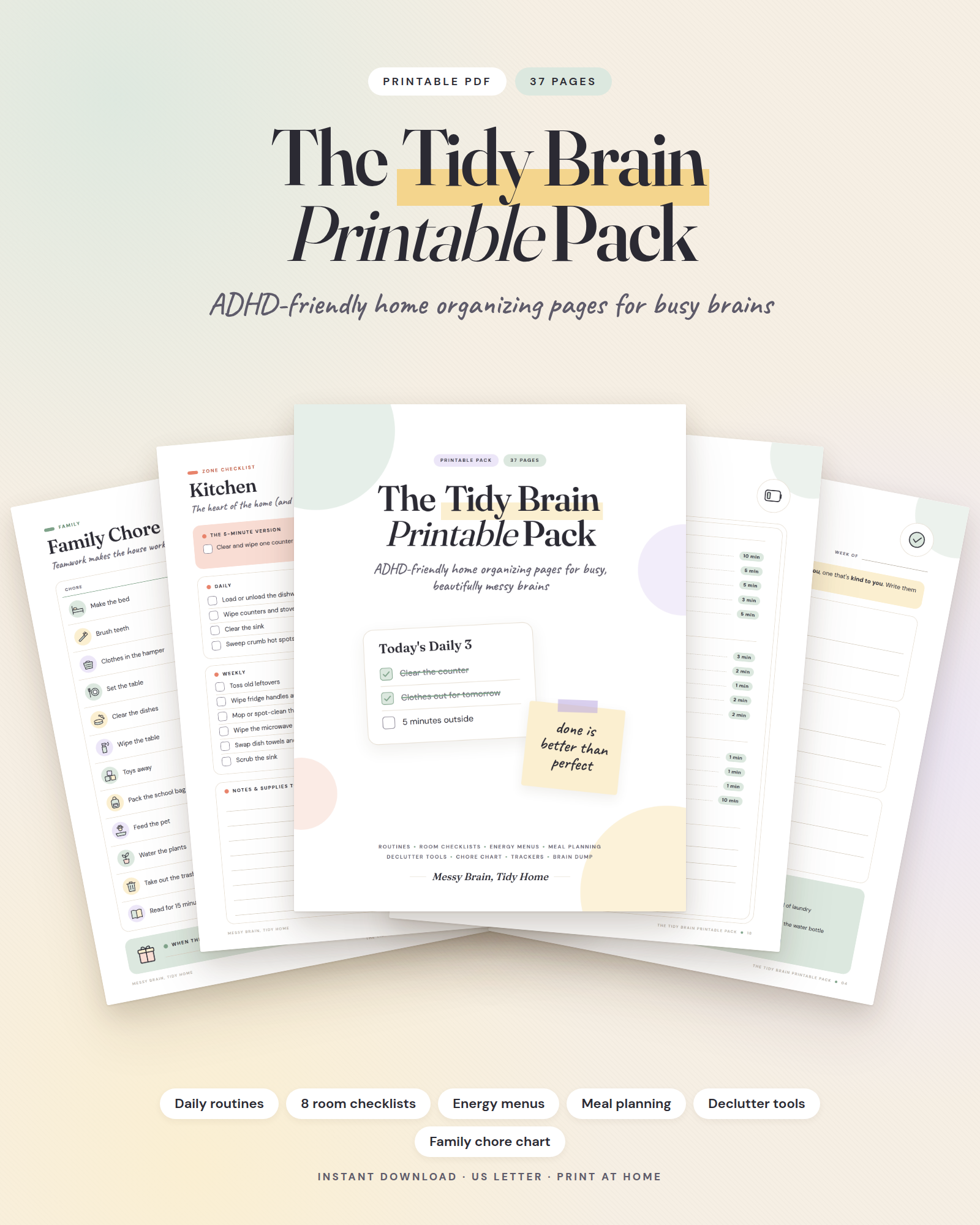
The Tidy Brain Printable Pack
Checklists, trackers and routines made for brains that forget. Print what you need, stick it where you'll see it.
Get the pack · $14